ServicesDentures
Dentures in Prosper
Loose, sore or missing teeth make eating and smiling harder than it should be. We make full, partial and implant-supported dentures, and the same small team takes your impressions, checks the fit and makes every adjustment until they feel right.
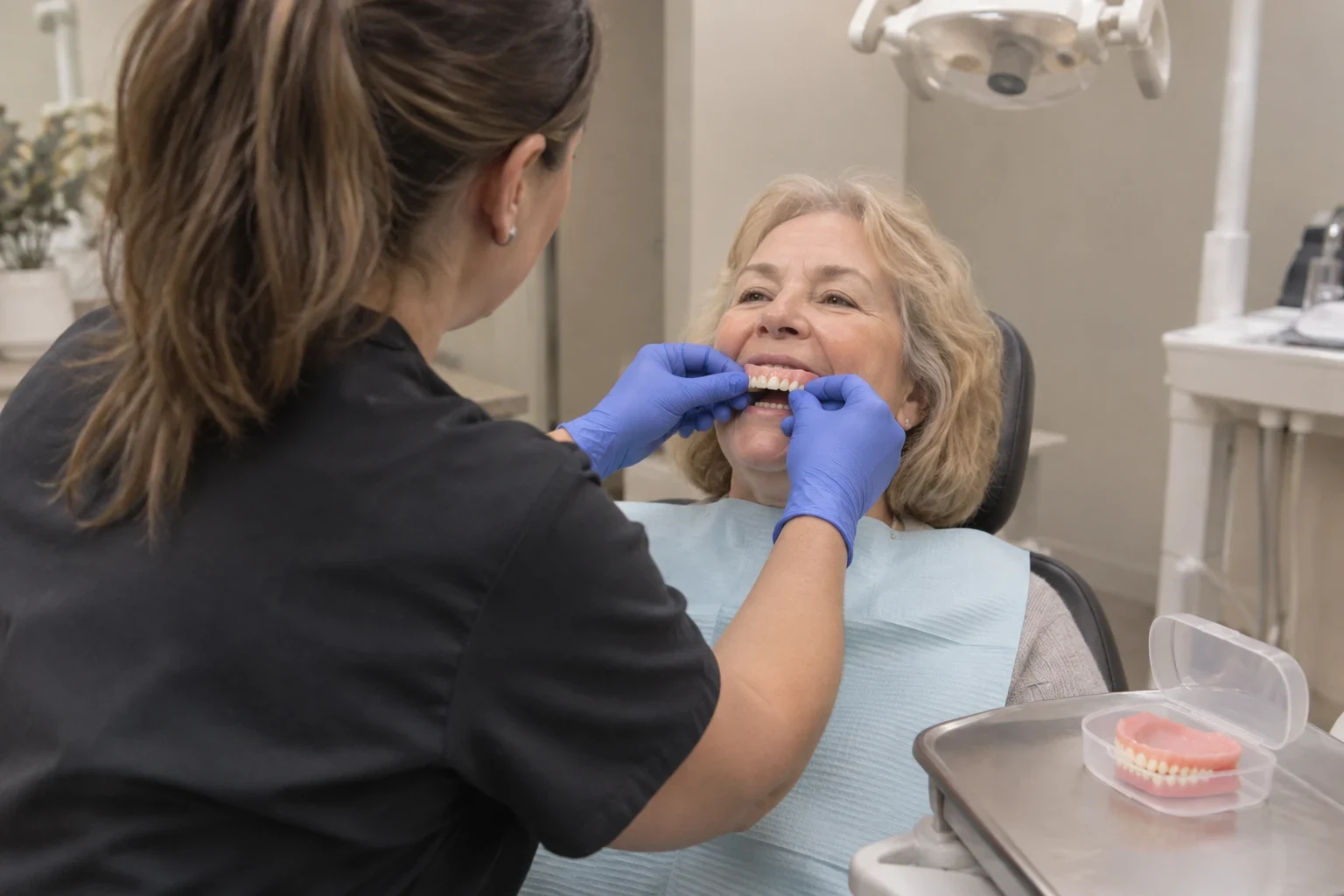
Who dentures help most
A denture is a removable set of teeth that fills in for many missing teeth or an entire arch, bringing back your bite and the natural support of your face. It's a good fit for patients who have already lost a lot of teeth, whose remaining teeth are beyond saving, or who want a reliable option that costs less than an implant for every tooth.
The difference between a denture you tolerate and one you forget about comes down to small things: how the base rests on your gums, how the top and bottom teeth meet, and how the set moves when you speak. Getting those right is easier when the people who took your measurements are also the ones fitting the final set. That's how we work with every patient, whether you live in Prosper or come over from Frisco or Celina.
Want a denture that doesn't shift at all? Ask about implant-supported options at your visit. Just a few dental implants can hold a denture firmly in place while you chew.
Denture options we offer
Full dentures
For patients who've lost every tooth in the upper or lower arch, we make a whole set. The base follows the contour of your gums, and the teeth are arranged to suit your bite and your face.
Partial dentures
A partial fills the spaces between your healthy teeth and hooks onto the ones still in place. It also stops those teeth from tipping into the gaps.
Implant-supported dentures
These snap onto dental implants set in the jaw. Many patients pick this route when a standard lower denture won't stay down.
Extractions before your denture
When some teeth have to be removed first, we take care of the extractions in our office and time the denture around your healing.
Relines and adjustments
Over the years your gums and bone shift, and a once-snug denture can start to move. We reline the base and relieve pressure spots to keep it comfortable.
Signs dentures may help you
Many teeth already gone
Gaps make chewing harder and let neighboring teeth wander. Filling them sooner protects the teeth you still have.
Teeth that are loose or failing
When a lot of teeth are badly decayed, cracked or loosened by gum disease, fixing them one by one may not be realistic. We'll tell you honestly which ones are worth saving.
A current denture that slips or rubs
Clicking, sliding or reaching for more adhesive each month usually means your gums have changed. A reline or a new set can solve it.
Skipping foods you like
If you're dicing everything small or passing on favorite meals, your bite isn't working the way it should.
Lips and cheeks losing support
Without teeth behind them, the face can start to fall in around the mouth. A well-made denture fills out that support again.
Your denture visits, step by step
- 1
Start with a $25 evaluation
Your first visit covers a full exam and digital X-rays, plus a CBCT scan if the bone needs a closer look. We go over your options, from partials to implant-supported sets, and give you the treatment plan and costs in writing before anything starts.
- 2
Impressions and bite records
We take precise molds of your gums and record exactly how your jaws meet. You help pick the shade and shape of the teeth so the result looks like you.
- 3
Wax try-in
Before the final denture is made, you try on a wax model. We check your bite, how you sound and how it looks, and change anything that feels off.
- 4
Fitting day
We seat your finished dentures, find any pressure points and smooth them right away. Before you leave, we show you how to wear, clean and store them.
- 5
Follow-up adjustments
A few tender spots in the first weeks are normal. Come back in and the same people who fitted your set will fine-tune it until eating and talking feel easy.
What shapes the price of your dentures
Every mouth needs different work, so we price your dentures after we've examined you rather than guessing over the phone. Your written treatment plan lists each step and what it costs. Our office is in-network with 15+ major PPO dental insurance plans, and patients without insurance can sign up for our in-house Membership Plan. We also offer 0% interest financing for up to 24 months, and seeing if you preapprove has no impact on your credit score.
- How many teeth you're replacing
- A single partial for a few gaps costs less than complete upper and lower sets. The plan grows with the number of teeth that need replacing.
- Work needed before fitting
- Taking out failing teeth or treating your gums first adds visits and steps before the denture can be made.
- Anchoring with implants
- Attaching the denture to dental implants raises the cost, but it adds a great deal of stability, especially on the lower jaw.
- Base and tooth materials
- Bases and teeth differ in how natural they look and how long they hold up. We explain the trade-offs so you can choose.
- How you're paying
- PPO benefits, our Membership Plan or financing can each reduce what you pay out of pocket. We go over your coverage with you at the evaluation.
Common questions about dentures
Something not covered here? (972) 635-4707
How long before new dentures feel normal?
For most patients it takes a few weeks. Speaking and chewing get easier each day with practice, and one or two adjustment visits usually clear up sore spots. Sticking to soft foods early on makes the first days easier.
Can I leave with dentures the same day my teeth come out?
Often, yes. An immediate denture is placed at the extraction visit so you're never without teeth while you heal. Gums shrink as they recover, so that set will need a reline or a replacement later. We'll tell you if it makes sense for your situation.
How is an implant-supported denture different from a regular one?
A regular denture rests on your gums and stays put through suction and a close fit. An implant-supported denture clips onto dental implants in the jaw, so it holds much steadier while you chew. The implants also help slow the bone loss that comes with missing teeth.
Will my insurance help pay for dentures?
Many PPO plans cover part of the cost, and our office is in-network with 15+ major PPO dental insurance plans. If you don't have dental insurance, our in-house Membership Plan is a way to lower your costs. In both cases, we go over what you'll owe before treatment begins.
How many years will my dentures last?
With good care, a denture can last many years, though your gums and jaw slowly change shape over time. Most patients need a reline at some point to snug up the fit. Regular checkups let us catch a loosening fit before it rubs a sore spot.
Ready to eat and smile with confidence again
Start with a $25 focused evaluation. We'll examine your mouth, explain your denture options and give you a clear plan with costs before anything is decided.